- Holistic Athlete Newsletter
- Posts
- Mental Monday - February 24, 2025
Mental Monday - February 24, 2025
Mental Health in Athletics Stats

Zachary Etter
February 24, 2025

Mental Health in Athletics
This past weekend I spoke at the New England Coach of the Year Clinic in Connecticut to discuss mental health and performance with football coaches. One item on the agenda was an overview of the current mental health landscape within high school athletics, and some of the challenges we’re going to have as a society to pull ourselves forward.
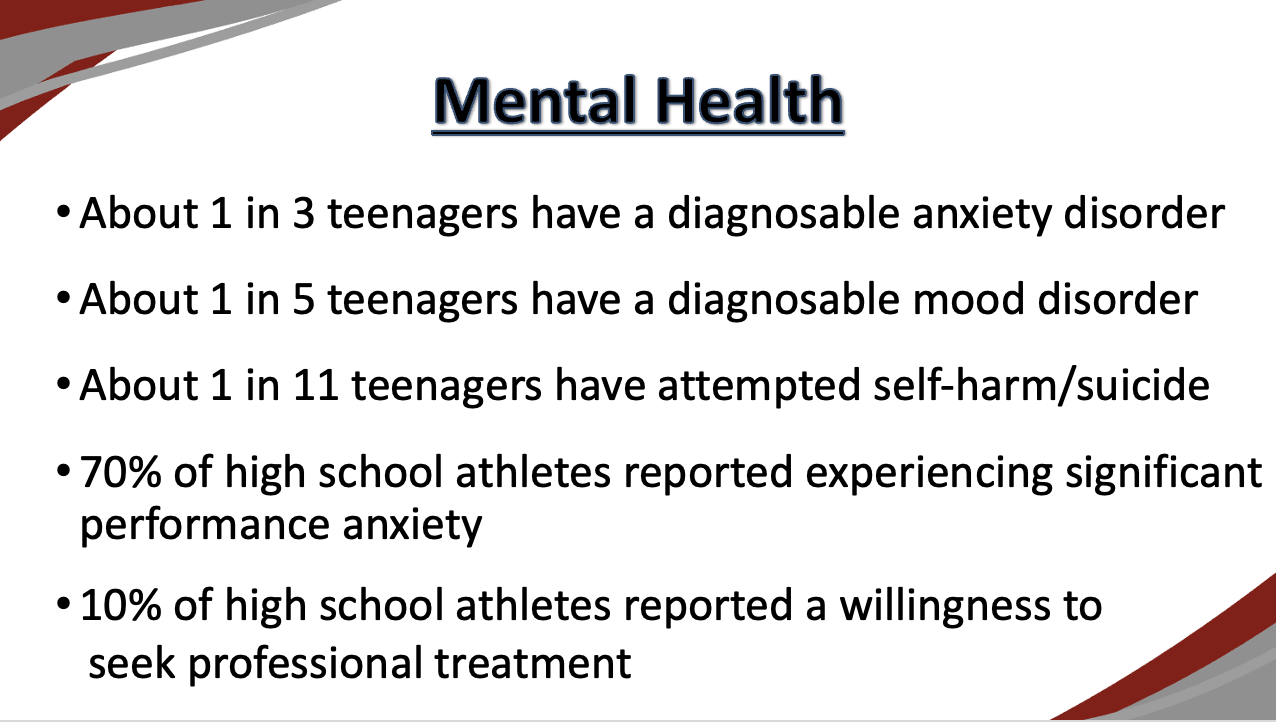
Understanding the data is important as a coach. Athletes are not immune to these statistics — in fact, in several key ways, athletes may struggle more often due to the stigma of mental health in sports, sacrificing other areas in their life for their sport, physical toll on their body, long days, travel, etc. The graphic also notes that athletes are less likely to seek help than the general population.
Contributing factors of poor mental health for teenagers: Excess social media use, technology, 24/7 access to unlimited content and (mis)information, poor sleep habits, poor diet, low resilience, poor coping skills.
In-season, your athletes might see you more often than they see their parents. While you’re certainly not expected to be a mental health expert, you may have the best opportunity to notice behavioral changes that could be warning signs for a teenager who’s struggling with their mental health. Be aware of the school’s process for referring students to get help, and have information about services that are available to them ready when needed.
Avoid Anxiety-Provoking Phrases
Anxiety is an evolutionary defense mechanism to survive in the face of danger. Obviously, in 2025, we are very rarely “in danger.” Instead, our anxiety is responding to fear (which is the emotion we feel to let our brain know that we’re in danger). These days, it’s more of a fear of failure, fear of judgment, fear of not meeting expectations, etc.
That said, we just talked about 1 in 3 teenagers struggling with a diagnosable anxiety disorder. Your athletes are prone to jumping into fight or flight mode (which makes it difficult to perform) unnecessarily.
Think about the literal meaning of terms like “need to” or “have to.” “We have to play better today,” or “We need to get this win.” The words “need to” and “have to” are telling their brain that it’s not going to be okay if we don’t. This signifies a level of importance being put on the situation that justifies an anxious response, and now you’ve put your athletes in a psychological space where it’ll be more challenging to play well.
Use words that are true and helpful: “It’s important to us to…” “We’ve been working towards…” “Challenge yourself to…” etc.
Holistic Athlete Services
If you haven’t done so already, sign up for the 11 module Coaches Education Course! Contact me for a discount code
Also if you haven’t already, please sign up for a Zoom call for you and your staff to discuss the specific needs of your team, to asses what services may benefit you, to review content from the course, and to discuss any challenges with athlete’s you’re experiencing.
Reply